The record sleeve depicted the blue glass tiles of the KaiserWilhelm Memorial Church in Berlin, where the cantata was recorded. Every ray of light passing through those small windows is drenched in calming blue, allowing visitors to fully immerse themselves in the space. The tiles form a fragmented night sky—stars, clouds, and a sense of quiet vastness. Being inside thechurch is a physical as much as an emotional experience. The site is a historical landmark that bridges Berlin’s past with its present without concealing its destruction. Built in 1891 and largely destroyed during the Second World War, the church was preserved as a ruin after the war, while a new nave, tower, chapel, and foyer were constructed around it, designed by renowned architect Egon Eiermann in the 1960s. Berliners call the ruin of the church “hollow tooth”, because of its distinguished shape, towering into the Berlin sky. The new ensemble is defined by walls made entirely of the aforementioned blue glass tiles. The artist responsible for these glass walls is French Gabriel Loire, who founded his glass workshop in 1946 in France and whose work is present in religious buildings all around the world, from all over Europe to the United States up to Japan.
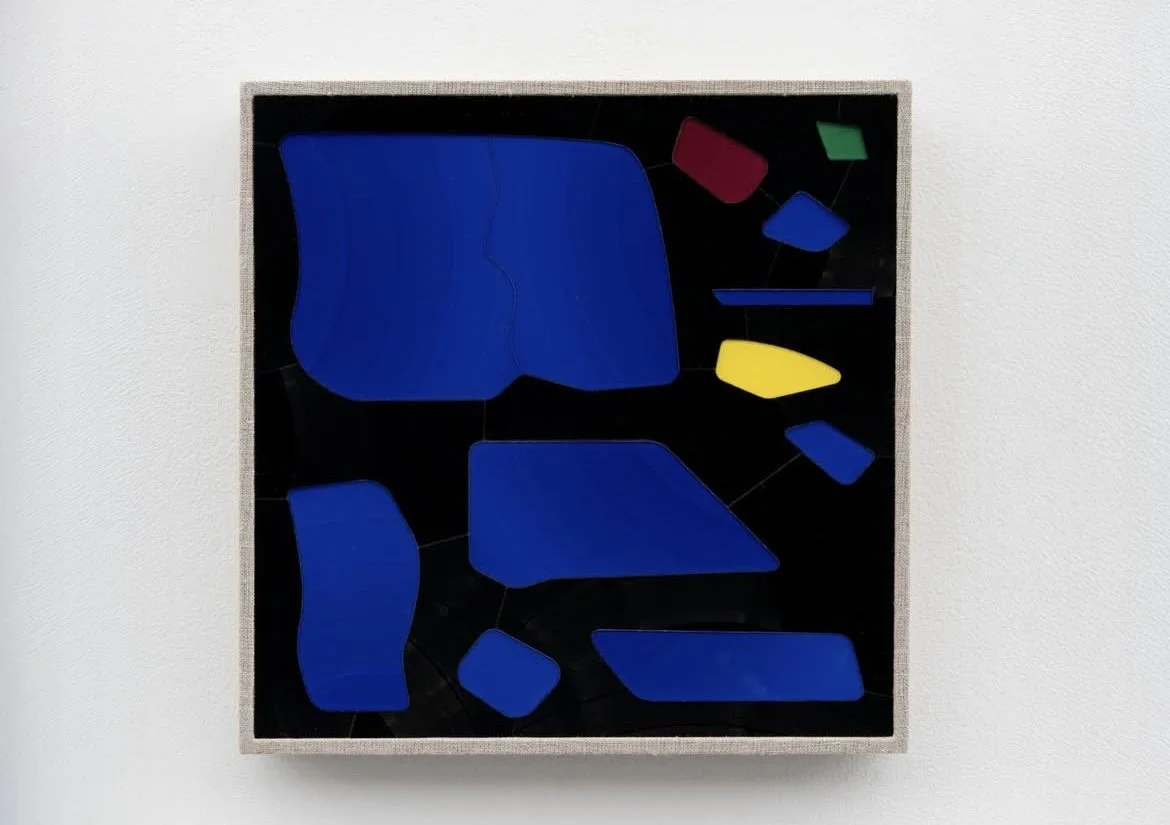
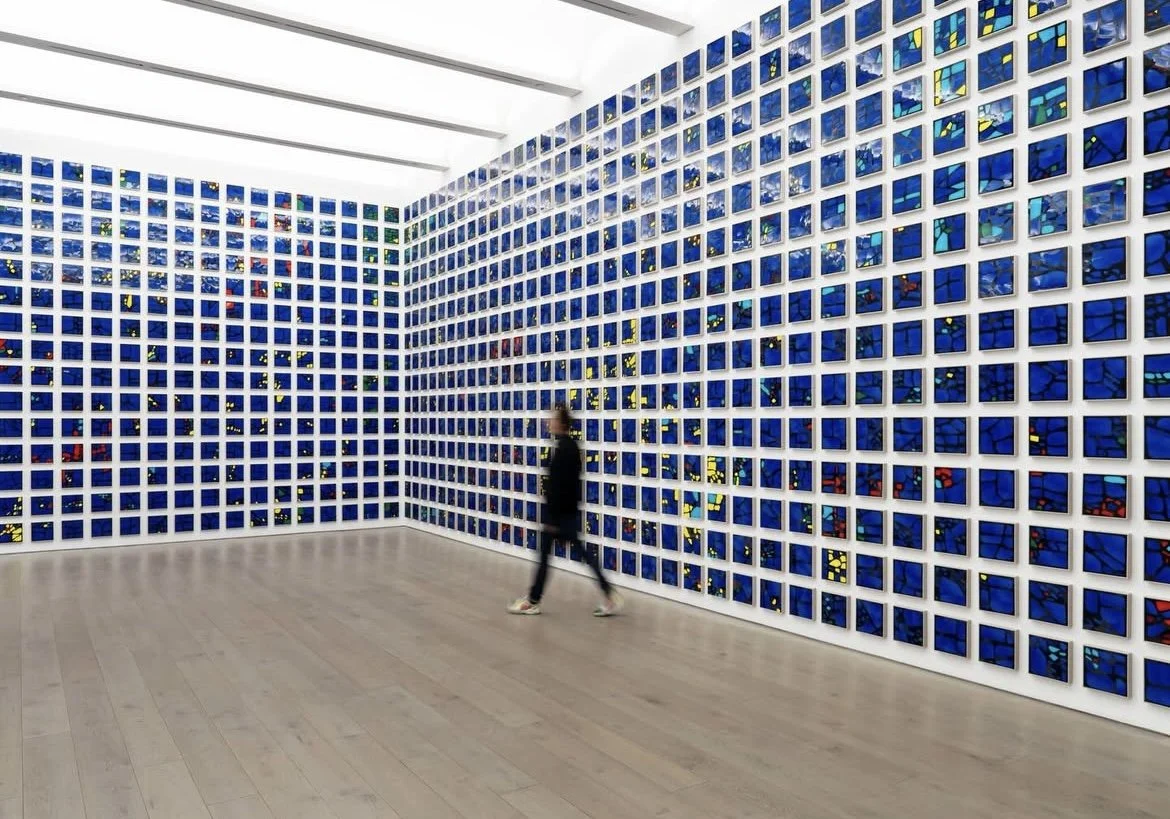
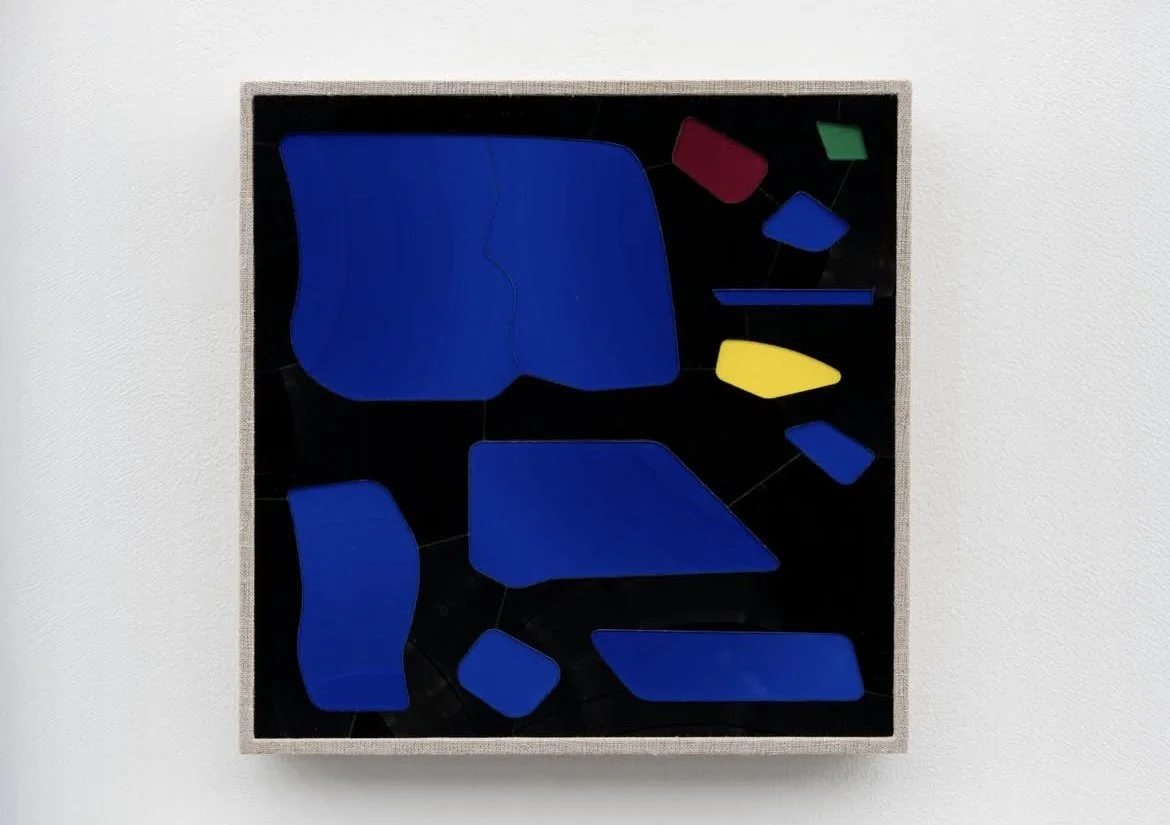
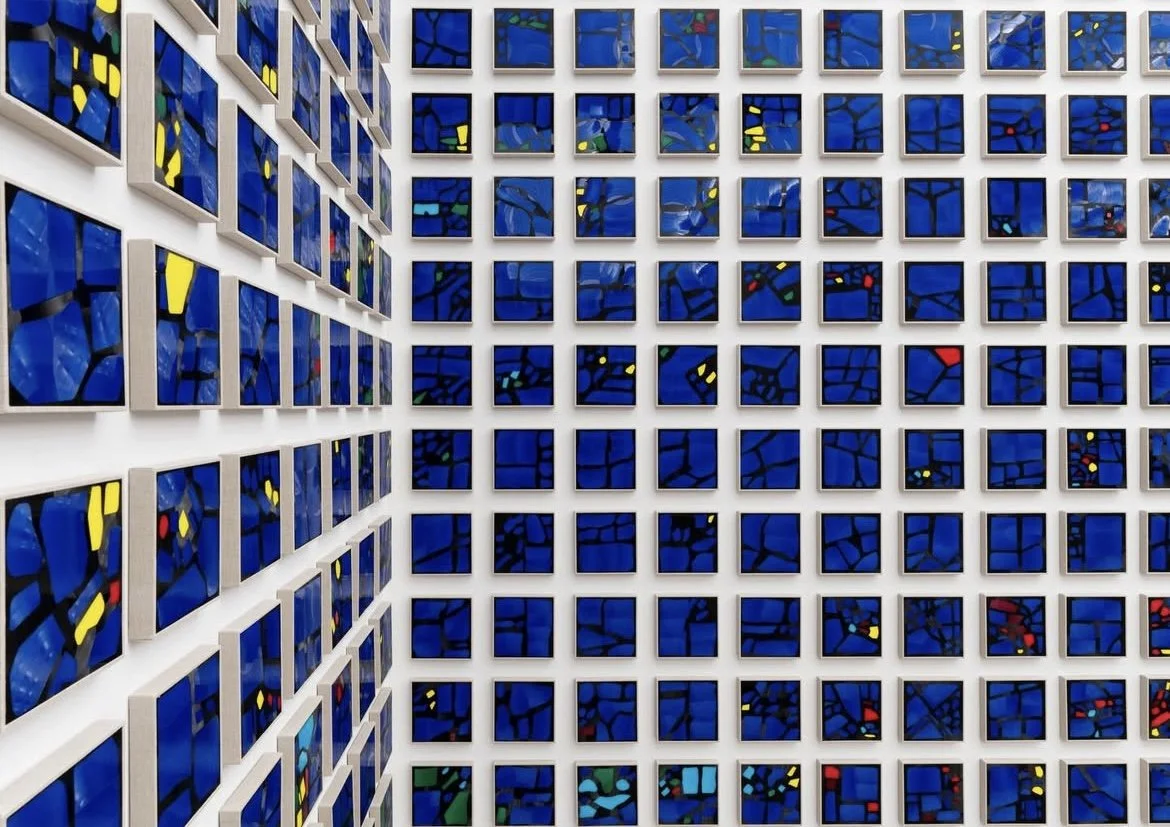
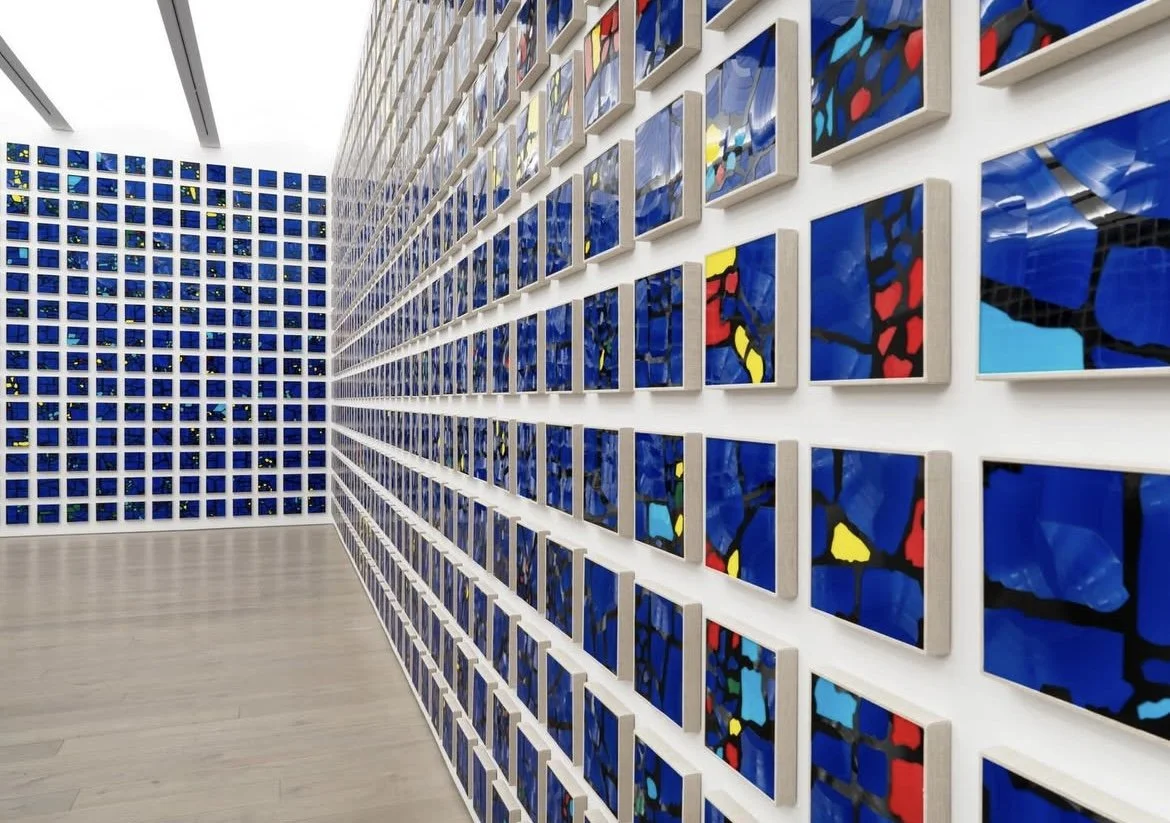
For Hildebrandt, holding the record of Bachs cantata with the image of the blue tiles, was the starting point for what would become Blue in Memoriam: a study of space, light, and memory— and, in a way, a meditation on sound and its absence. The work consists of nearly 3,000 tiles made from more than 8000 vinyl records that Hildebrandt pressed specifically for this project. Each tile measures 24,1 × 24,1 cm, mirroring the dimensions of the church’s original windows and is meticulously cut with a water jet, in order to achieve the pattern. Up close, the grooves of the records remain visible, a detail Hildebrandt considers essential; the grooves function like a painter’s brushstroke, structuring the intimate space of each tile and pointing toward their former life as carriers of sound.
The resulting tiles evoke the chromatic luminosity of the church’s windows and simultaneously shift the viewer’s perception of the exhibition space. Their material presence—vinyl masquerading as glass—creates a subtle tension between surface and reference, memory and reconstruction.
Hildebrandt’s engagement with windows and vinyl extends far beyond this project. His earliest experiments involved recreating the colored-glass window from his grandmother’s home in southwest Germany, an intimate gesture that evolved into a broader investigation of how spaces can be rebuilt, remembered, or reimagined through sound-bearing materials.
The records sacrificed for Blue in Memoriam originate from Anne, a German band whose albums Hildebrandt produces through his label Grzegorzki Records. The choice is not incidental. Hildebrandt’s artistic practice is deeply intertwined with music, yet his artworks remain silent. The act of pressing, breaking, and reconstituting vinyl becomes a way of giving the latent, muted sound a new spatial and architectural form. For this installation, Hildebrandt used the B-side of Anne’s album Flamingo—melancholic, rhythm-driven music that now lingers as a physical echo within the exhibition space.
Such translation—from sound to space—is central to Hildebrandt’s practice. His oeuvre is filled with works that obscure, store, or disguise sound: audio tapes unspooled and fixed onto canvas, recordings transformed into sculptural material, magnetic tape stretched into beams that physically interrupt a gallery. Works such as Schwelle gekreuzt (2020), in which wooden beams made of magnetic tape force viewers to adjust their movement, demonstrateHildebrandt’s ability to literalize sound as obstruction, as presence, as architecture.
With Blue in Memoriam, this transformation reaches a new level of spatial ambition. Enveloping the room entirely in vinyl tiles, the installation creates an environment that is both immersive and reflective—an echo of sacred architecture transposed into a contemporary context. The blue light radiating from the tiles evokes the sublime quality of entering a church, yet the material insistence of the vinyl roots the experience in the physical and the present.
Blue in Memoriam goes even further. Covering the entire room, the tiles generate a complex physical encounter that exceeds the visual. They recreate the sublime feeling of entering a sacred space, transporting viewers across time zones and geographies— from Berlin to New York, across decades and artistic languages. It is not a work one glances at and walks away from. Instead, it invites visitors to linger, to observe how the space alters their perception, and perhaps to see their surroundings differently after bathing in its blue light.
Hildebrandt’s work turns music into architecture, weaving together cultural references from different eras and genres. It binds the private to the public and transforms memory and experiences intosomething capable of transcending both space and time.
— Laura Helena Wurth
PRESS CONTACTS
Caitlin Merrell, Perrotin New York
caitlinmerrell@perrotin.com
Jackie Inman, Perrotin New York